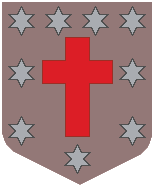
The Origin of the surname MIZZI
The Maltese surname Mizzi is of patronymic origin. Patronymic surnames derive their origin from the personal name of the original bearer. Mizzi is derived from the Italian personal name of Giacomo (the Hebrew name Ya’aqobb). This was Latinized first as “Jocobus” and during the Dark Ages as “Jacomus”. Jacomus was widely used as a first name throughout Europe from the earliest times. The English surname, James, first listed in 1187, is one of the earliest recorded surnames deriving from it. This was because England was the first country to adopt hereditary surnames, public registers, and charters. In the case of the Mizzi surname, Jacomus became Comizzoli, then Mizzo, and finally Mizzi.
In Malta, the earliest known Mizzi was from Zurrieg in 1480. There is also a reference to a Mizzi who was a Jurat (Mayor) of Notabile in 1582. In 1551 the island of Gozo was raided by the Turks and almost the entire population was carried away to slavery. Since most of the remaining Gozitans fled to Malta for “safety”, the island was practically abandoned. Between 1565 and 1580 there was a drive to repopulate Gozo and many people from Malta and other countries settled there. The earliest known ancestor from our Mizzi family was Pietro, who settled in Gozo around 1590.
Our Mizzi Ancestors
Dr Placido Mizzi was our first Mizzi ancestor of note in Gozo. He was a lawyer but is listed in the Malta Government Gazette, issue 6/1/2006, as having worked also as a Notary between the years 1764-1786. Since then the profession of Lawyer has been passed on from father to son(s) until today.
Dr Francesco Mizzi, Placido’s grandson, married a Maltese girl and settled in Malta. On April 30, 1885, Francesco, as Magistrate for Malta, gave his judgment in the notorious Rapinet case (Histories of Malta, vol 1. by Giovanni Bonello).
Dr Fortunato Mizzi, Francesco’s son, was founder of the Anti-Reform party, later known as the Partito Nationale and today as the Partit Nazionalista. He opposed taxation decreed by the British colonial authorities and measures to anglicize the educational and judicial systems. Dr Mizzi fought so valiantly for Malta’s rights during early British rule that he became known as “Padre della Patria”. Dr Fortunato was married to Maria Sofia Folliero De Luna, descendent of a well known family from Naples.
Dr Giuseppe Mizzi, Fortunato’s son, besides being a lawyer, was also a journalist and between 1910 and 1927 was director of the Newspaper “Malta” which he had inherited from his father. He made his political views known through writing articles and patriotic poetry in his newspaper. One of his more well known poems, “L’Ora Solenne”, was published in the “Malta” on 26th February 1919.
Dr Enrico (Nerik) Mizzi, Giuseppe’s brother, continued his father Fortunato’s struggle for Malta’s autonomy. In 1942 he became leader of the Partit Nazionalista, and in 1950 Prime Minister of Malta. He initiated the drive for Malta’s independence which was achieved in 1964. During his life Nerik was known as “Il Cavaliere senza macchia e senza paura”.
Dr Fortunato (Effie) Mizzi, Giuseppe’s son, followed in his family’s footsteps and became involved in politics early in his career. He was Minister of Justice and Minister of Education in two separate administrations. In 1953 he went back to working as a lawyer till he was appointed Magistrate. Later he was appointed Judge, and lastly Appeal Court Judge. Dr Fortunato was married to Helen Grech Cumbo.
Dr Fortunato had four daughters, none of whom became lawyers. His brother, however, Dr Edgar Mizzi, was also a lawyer and two of his sons became lawyers. So the Mizzi tradition goes on…..
![]() |
![]() |